Showing posts with label rabigh. Show all posts

Sunday, 11 January 2015

The Penultimate Post?

T minus six days until lift-off...inshallah.
Boy, am I ready to get out of here. I haven't had a good night of sleep in five days or so. Evidently, my body has decided to protest Saudi Arabia, and is pretending I'm in Canada already. I don't get tired until twelve in the afternoon, and by the time twelve midnight rolls around, I'm no longer tired. Why would I be? That's lunchtime in Vancouver, after all.

I can't fix it with drugs. I went to one pharmacy to ask them for sleeping medication. They gave me antihistamines. Not surprisingly, they didn't help. I went to a second pharmacy, and they gave me actual sleep medication made with Valerian root. I took a double-dose, but no luck. My usual go-to, melatonin, which is available over the counter in every drug-store in Canada, is no where to be found, much less prescribed.

I've been up all night trying to sleep, and too tired during the day to do much of anything. I imagine, this is what purgatory is like.

Come to think of it, this past month has been rather purgatory-like. Since coming back from my final vacation in Budapest, due to a lack of new student admissions, I have been allowed to fulfill the remainder of my contract relaxing at home. I know, poor me, right? The problem, is I'm stuck in Rabigh. Christmas and New Year's came and went. There were no celebrations, no merry-making, and indeed, barely a mention of the holiday at all.

It wasn't that depressing--I have only spent two Christmases at home in the past five years, and even when at home, my family generally doesn't make that big of a deal out it. I went for kebab with my colleague, Dave, one of the few non-Muslims I know in Rabigh. Afterwards, I went home. I probably had tea later with friends. Purgatory.

Indeed, discounting the vacations, that's really been what this year has been like--a big old meh. These days, when trying to go to sleep, I just try to focus on the void. The void is empty, it's big beyond imagining, and incredibly peaceful. But I can never hold my attention on it for long, and I end up laying in bed for eight fucking hours, getting more and more frustrated. I'm not ready for this bland existence. I don't want my life to be meh anymore. I want to have a little color in my life. Even if that leads to more hang-overs and heart-aches, so be it, at least live will have some flavor. Next year, I want to put up a Christmas tree, and later, puke over somebody's balcony. They have Christmas in Japan, right?

I had hoped to be filling these meh days with scuba dives. The one thing I really wanted to achieve before leaving Rabigh was getting my PADI license. Even though a group of us started in November, we have yet to finish, and were I to leave things in the hands the others, I would never get my license. So after much cajoling, I've attempted to get it done without the group. I've met privately with the instructor to write the final exam, and have arranged with him to do my final dives this Thursday and Friday--my final two days in the country. I've been pushing for this for months, and if it actually get's done, it's going to be right on the wire.

Similarly, I feel obliged to harass HR for my plane ticket home. After much haranguing, I have obtained my final exit visa, and form for my final payment remittance...but I've got less than a week left in the country, and still no ticket. It's imperative that I acquire it on time as my passport expires only a few days after my end of contract date and every day that I'm stuck here, in purgatory, is another day I won't be able to spend with friends and family before shipping off to Japan in February.

Give me heaven, or give me hell, just get me out of here, Allah.


Sunday, 30 November 2014

When It Rains, It Pours

Nine months out of the year, it's hellishly hot in western Saudi Arabia, and during that time, there's so little condensation that if it 'rains', it usually comes down as dirty globs of spittle for about an hour and then stops completely. Luckily, from November to January, the weather is actually very pleasant, and occasionally, it actually rains proper rain...which tends to lead to utter fucking chaos, since there isn't the proper infrastructure to deal with it!

Recently, at our school, a few minutes into the fourth block, it started to rain--not in the aforementioned "spittle" way, but real, honest-to-goodness, civilized world kind of rain. Of course, all of the trainees rushed to the window to witness this most wonderful of natural phenomenons, as if it was the first time in their lives they have ever witnessed such an event. Water? From the SKY? What strange magic is this? Basically, once it starts raining, there's a camel's chance in Siberia that the students (being a mere twenty-two years old, on average) will be able to pay attention, or go to the next class.

And so it was when in really started coming down. Now this building wasn't built with rain in mind, so there are electrical outlets on the floors--like actually coming out of the floor itself. And, rain has a habit, in some classrooms of coming in through closed windows, pooling on the floor, and creeping towards the electrical outlets. Such was my concern while the students all crowded outside to check out the rain. We ended up cutting off the electricity to the buildings and letting the students go, which was kind of nice, because we got half of the day off too.


I took the opportunity to drive around with a colleague and take pictures of the city. For a while, I felt like Rabigh wasn't so bad, after all.

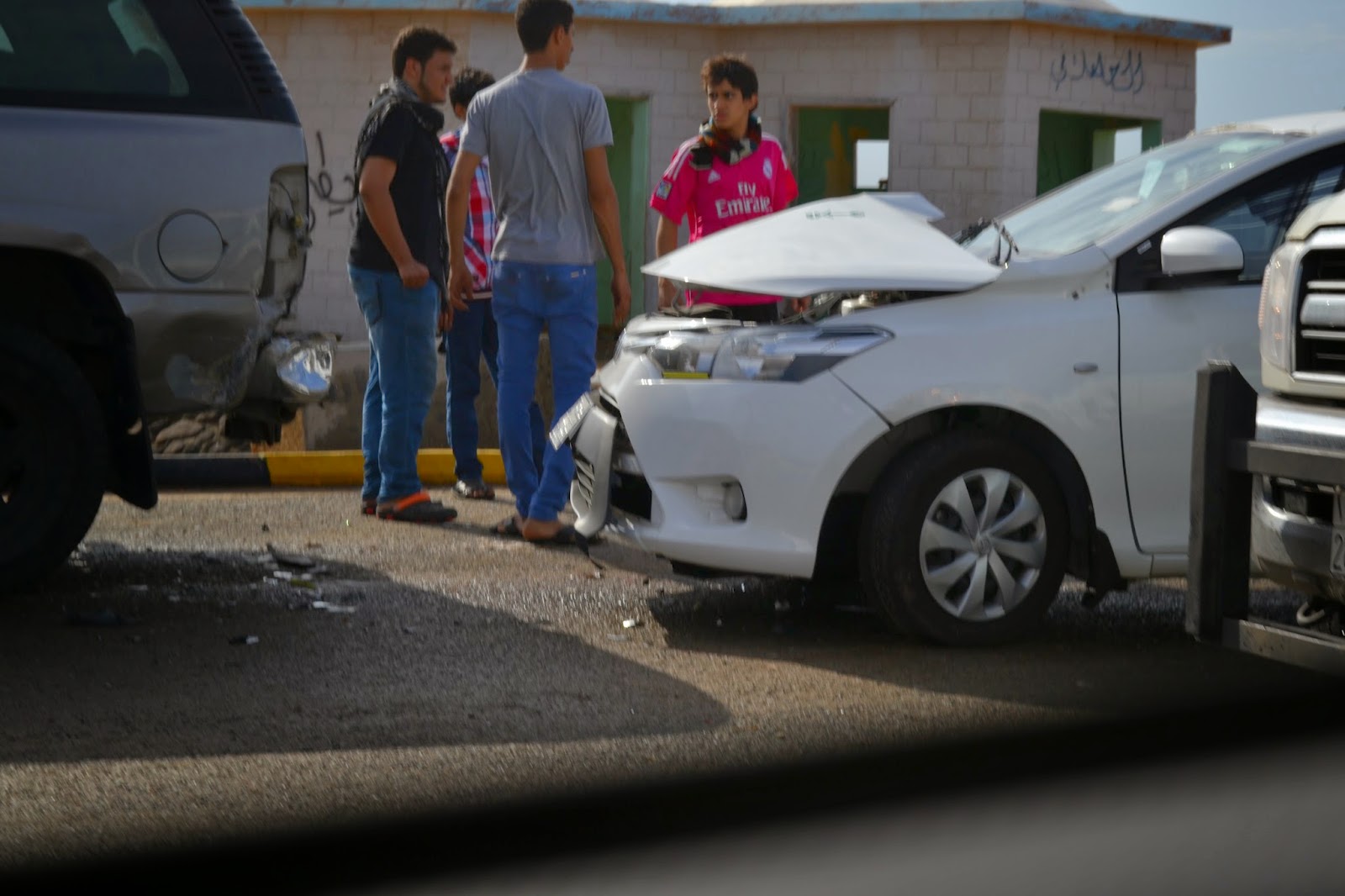
Riding around, we could see big pools of water here and there, on and off the street. Not surprising, seeing as how there are no storm drains, or even a sewer system in Rabigh. Also not surprisingly, we saw a couple car accidents. Bonus: while driving around, we saw a herd of camels too!

All in all, it was a pleasant afternoon off, and all thanks to Saudis having no idea how to cope with rain. It happened again Sunday morning, so school was cancelled again...even though it turned out to be a sunny day. The best part: this was all on the heels of the king asking everyone to pray for rain!


Friday, 16 May 2014

Soccer Sunday


Before coming to Saudi Arabia, I was a little bit put off by the prospect of not having access to alcohol for three months at a time. For me, drinking alcohol has long served as the de facto reason for getting people together. But, in Saudi you have to find reasons to get people to congregate. My favorite of these is soccer.

So, why soccer, and not some other sport? Soccer is the appropriate game for the environment. There are no ice rinks, so hockey is out. There are no baseball fields, so baseball is out. There are no football--well you get the idea. Even in a small city like Rabigh there are several soccer pitches. They have sufficient lighting, and they are cheap (one hundred riyals per hour). In the day time it's much to hot to play but in the evening, it is very pleasant indeed. It's cheap, it's fun, its a good way to stay in shape, and it's an excellent way to socialize in the absence of alcohol. 

I started playing soccer in Korea, when I was thirty. I'm thirty two now, and just about everybody on the field has significantly more experience than me. I try to make up for it in enthusiasm. Also, I'm bigger than most people on the field and I'm (for better or worse) not afraid of getting injured. Unfortunately, I seem to have a tendency to injure other people on the field, despite being careful not to foul.  But I'm always getting better, and I'm beginning to rely more on finesse and less on brute force. Playing soccer has been a great reminder for me that it's never too late to start something new.

At first the pitch was rented by school, for the benefit of the employees but some of the players had bad attitudes, so it became harder and harder to find enough people to come out and play. The the poor sports were the guys responsible for renting the pitch, so when people stopped showing up, they decided discontinue the whole exercise. But my colleague Ahmed, and I took this as an opportunity, and started renting the pitch ourselves. We bolstered the ranks with our Spanish friends, and soon our  disenfranchised co-workers began to come back. We've been playing twice per week ever since!    

Although there has been a fair bit of altercation on the pitch, playing soccer has been, and continues to be a very satisfying and worthwhile practice. It's reinforced friendships with colleagues, and created new ones with the Spanish guys, and whomever else decides to come out and play. Sometimes students from the institute come out, too, which is nice, because we get to interact with those guys without playing the authoritarian teacher role. It's nice to just play together on the field where everyone's role is equal...and you don't have to remind them to turn off their cellphones!

Saturday, 26 April 2014

Sand Storm

Ninety-nine per cent of the time, the weather in Rabigh is the same: hot and humid. Perhaps that's not accurate: ninety-five per cent of the time the weather here is either hot, or ridiculously hot. Another four and three quarters per cent of the time, it is comfortably warm. But occasionally, it does rain, although it's not the kind of rain that I am used to.

As I remember back to January, driving into Rabigh from the airport in Jeddah, I remember seeing a sign on the highway warning that it was a sandstorm area. In my mind, I imagined vicious two-hundred kilometers per hour winds, full of sand, that would shred the skin off one's face like an industrial grinder.

Well, my experience of a sandstorm in Rabigh was a much different affair. I was going out for dinner with my neighbor and colleague, Rowa. It was about a seven minute walk to the restaurant from our apartment building. It was a night like any other, except it was a bit cooler (in the tolerably hot category).

We weren't in the restaurant long, perhaps thirty minutes at the most, but it was remarkably cooler and a brisk wind was picking up, and it was drizzling. The streets were deserted (although this may have been in on account of prayer time). The wind was getting stronger and stronger, then inexplicably it began to rain...mud.

Now, it's wasn't exactly pouring, and there weren't big globs of the stuff coming down, but the water in the air has mixed with the ever-present sandy particulate, the result was everything getting coated in this brown, watery mixture. I was a little bit afraid that the wind would get so intense that a more liquidy version or my initial vision would come to pass. But it was not to be so.

All in all the experience was bizarre and intriguing, though it posed very little danger!


Monday, 21 April 2014

Living With Islam in Saudi Arabia


What is it like living as a non-Muslim in Wahhabi Saudi Arabia?

I meditate and I am student of Buddhist scripture, but I don't think of myself as a Buddhist. Under the religion field on my iqama, it says "unspecified". I like that it doesn't say "athiest". There is baggage that comes with that term. Usually it means an ego-centric perspective, a closed mind, and an outright denial of the supernatural (in whatever conception). "Agnostic" is better, but I prefer "unspecified." And the term is pragmatic: it allows me to work here, while if it said "athiest," that  may not be the case.  

When I am out and about, and mixing with the locals, and I meet someone new, usually the first question I am asked is, "are you American?" To which I respond, "No, I'm Canadian." Which is usually met with nodding approval. The next question is, "Are you Muslim?" To which I reply "No," and am met with silent disapproval...or an enthusiastic, impromptu attempt at conversion.

Sometimes I tell them I have no religion and sometimes I tell them I'm Buddhist. I'm not sure which is the worse response. When I tell them I don't have  religion, I'm always asked if I believe in God. But when I ask what God is, they just get confused, as if they had never considered the question before. Well, I get confused too and I've considered the question a good deal. In any case, I know better than to engage in a theological debate. I just try to communicate that I'm not sure what God is, anyway, and therefore, I'm not ready to accept Islam...which is usually not a satisfactory answer. When I tell them I'm Buddhist, they are similarly confused...perhaps because they don't know anything about Buddhism. But they know it's a religion, and it's not Islam, so it's not what they want to hear.

I don't disapprove of Islam. I can see how praying, fasting, adhering to a clearly defined set of ethics and living a life of devotion can be beneficial for some. I can see how it can be really beneficial for others. I don't think it's a bad way to go, all-in-all, and living here has made me much more sympathetic to Islam. It's not the malevolent force the Western mind sometimes imagines it to be. The quality of the religion depends on the practitioner.  

There are some very serious practitioners here--especially coverts and native Saudis of the older generation. These are the ones who get the most out of Islam. They pray five times a day. They are careful that their actions are virtuous (halal) and not sinful (haram). They practice whole-heartedly, and they are devout. I've met a few like this and they are good and happy men.

But for some Saudis, particularly young ones, being Muslim seems more of  an obligatory posturing than genuine faith. Sure, they may go to the mosque to pray, but they may nearly run you over with their cars on the way there. Sure, they may observe Ramadan, but they may also run off to Bahrain to go drinking and whoring when the month is over. 

Islam is not a choice for Saudis. They are born Muslim and they are expected to act Muslim.  For an ex-pat, being non-Muslim is not always accepted, but it is for the most part  tolerated, provided you follow the rules.

Islam is an inexorable part of Saudi culture; this society is built around it. I could live here twenty years and speak the language fluently, and never feel culturally integrated without adopting Islam. On the other hand, if I were to become Muslim, I feel like I could integrate...and I think that says something significant, because having lived in Korea for two years, I can say with confidence that I could spend twenty years in Korea, religion or no, and still not feel culturally integrated there.

Tuesday, 11 March 2014

All About The Teaching Environment and Getting Paid

Recently, a reader asked me some very valid questions, which I am sure are on many an ESL teacher's mind who may be reading this blog. Today, I will answer some of those questions, in particular those about the teaching environment.

Firstly, the classrooms. My classrooms is some 125 square feet, which isn't huge, but not bad for the task, since there are only 15 students on the roster, and very rarely do more than ten show up at a time. In my particular class room, there is a large whiteboard one wall, and another is used for a digital projector. I sit at a desk with a computer, and the students sit in chairs with flaps that fold out to hold their books. The setup is a bit different from class to class. In some rooms there are e-podiums or smart boards for the teachers, and in some the students have desks. It just depends.

In the English foundation program, which I teach, our primary coursebook is Touchstone. We are free to teach the material as we see fit. We can bring in new material, skip stuff in the book, or whatever. As long as the content gets covered, it's all good. We teach other material, but we can skip over most of it if there isn't time. The main thing is that we teach the Touchstone books, and a course in study skills. The students only get graded on those two courses.

The trainees are great guys but many of them are terrible students. So, despite the fact that they are in their late teens to early twenties, a lot of classroom management goes on. You can read more about the particulars in my recent post about the students here.

My co-workers are a really great group of guys. The youngest is in his mid-twenties, and the eldest is perhaps in his early fifties. Most of them are from the United States, Canada, Britain or Jordan. Many of them speak Arabic, and many (although there is no absolute overlap) are Muslim. None of them has ever tried to convert me to Islam, and all are tolerant of my choice of religion. Nearly everyone speaks English at the institute.

Working hours are 7:30 to 3:40. Our salaries are based on twenty-four contact hours per week. We get paid overtime for anything beyond that at a rate of 1/100th of our basic salary per hour. The rest of that time is technically office hours, although we may eat breakfast and lunch at the school canteen if we like. If we need to get business done off campus, the administration is usually really good about letting us go. 

We are on a trimester system, and we get time off every three months. We only teach class nine months out of the year. The rest of the time is dedicated to preparation, staff development and vacation time. We get a lot of vacation time. Exactly how much, it just depends, but it's a lot more than in Korea, for example. We also get two weeks of national holidays off. Most, if not all time off is paid.

My company in particular is very good about paying staff on time. I've heard about there being issues at some other institutes, but  ESL schools in KSA make a good deal of money and not getting paid on time is the exception, rather than the rule. We get paid in Saudi Riyals which are deposited directly into our Saudi bank accounts, or if we have yet to set those up, we are paid in cash. (Riyals, of course.)

We can, of course wire money into our home bank accounts. We can do this online without going to the bank.

Hopefully that answered some of the pressing questions some of you had. In the next episode, I will discuss accommodation! 


Saturday, 8 March 2014

Saudi Wedding Party

Last weekend I had the pleasure of being invited to a Saudi wedding party. Although, it was much different from the kind of celebration I'm used to, and although, I hardly knew anyone there, I had a nice time. Unfortunately, I'm having  technical difficulties with my camera, so inshallah, the photos will be forthcoming in the near future.

I was invited to said party by a Saudi gentleman I had met the week before. He had invited our mutual friend, my colleague, a Jordanian, and extended the invite to me.

The party took place on a sizable compound, which was presumably reserved for such occasions--or more accurately, one half of it. The other half was reserved for the female attendees. I was admittedly under dressed, but even had I  worn nicer shirt and pants, I would still have felt so, because the Jordanian and I were literally the only two people there not wearing thobes. A thobe, for those of you who may not know, is the Saudi equivalent to a suit. It's basically a robe with sleeves and a collar. They are usually white, and worn with a checkered scarf called a gutra, which is worn on the head.

Upon arriving, we were obliged to shake hands with about twenty gentlemen in a line. These were the closest relatives to the bride and groom. It was a little nerve racking, but their attitudes were either of boredom with the process, or genuine delight--not disdain for an infidel interloper, as was my worry.

The Jordian and I met our friend briefly and then sat down in a large hall, where we met an elderly man named Mohammad. I introduced myself, and chatted the best I could with my smattering of Arabic. He was a very pleasant fellow indeed. He taught me a few Arabic words, and told me a bit about himself. Amazingly, the man had nearly twenty offspring!

We sat (on the carpet) for about twenty minutes, chewing on dates, and sipping Arabic coffee and tea, the food came out: a colossal plate of rice and goat (or lamb, I'm not exactly sure) meat, which was shared by five of us. We were able to get through about two thirds of it. The rice had been boiled in fresh broth and it was delicious. The meat was excellent. We ate with out hands in true Saudi fashion.

After the meal, we sipped tea, and socialized for a while, and I met a Saudi fellow, who has spent some time in Vancouver. He was a nice guy, and he spoke English fluently. After half and hour or so we went into the main area of the hall, where, most of the guests had already gathered in a large circle. Drummers were drumming, and and singers were singing. At intervals, guests would run into to the middle, jump high into the air and spin in a circle. As they continued to spin, on the ground, their friends would come into the center with them and everyone would clap rhythmically as they spun.

After some time, a man produced some scimitars, and there was dancing and parading about with those. It was very...phallic.

It was an interesting cultural experience, that I was glad to take part in. However, I can't help but thinking it was lacking a certain crucial element of wedding parties--female interaction! Well...that and booze, although I imagine certain parties may have taken part in the latter, behind closed doors, after the public event.  

Monday, 24 February 2014

Arabian Food

When I went to Korea, I lost ten pounds in the first month. Despite getting exercise every day, I've gained ten pounds since coming to Saudi Arabia. That's the nature of Arabian food.

Arabians love rice and meat. Often that's all that dinner consists of--about a kilo of white rice and a large portion of lamb, goat, beef or camel. Where's the salad, you ask? What about the soup? It's back in whatever pansy country you're living in. You want vitamins? In Arabia, after your two kilos of rice and meat, you can have a pint full of fruit covered with honey.

Honestly, I'm not sure that some Arabians even know what a Salad IS. Besides rice and meat, other staples are: dates, soft white cheeses of all kinds, olives, flat bread, soft baguettes, nuts of all kinds, halva, and a banana-oatmeal mash covered with honey. Common restaurant foods include: fried chicken (inexplicably referred to as "broast") and fries, kebab, and chicken "sandwiches" (roasted chicken and french fries in soft tortillas). It's as if a panel of experts got together, for the sole purpose of creating the most calorie-laden national menu possible.

The aforementioned juices are a real boon. Soft drinks are ubiquitous, but only slightly less common are fresh juices. Common flavours include: orange, apple, pomegranate, guava, mango, strawberry, and avocado. The avocado juice is surprisingly good...and suspiciously sweet. Actually, you have to be careful of theses fresh juices, because unless you tell them specifically not to add and sugar, they're going to add a ton. Fruit juices are also very common at corner stores and super markets. They usually come in small glass bottle, and contain just about as much sugar as possible, while still deserving the moniker "liquid".

Fortunately, for those who wish to avoid early death from diabetes, there are a range of foreign (non-middle-eastern) foods available, to cater to the various foreigners. The most popular are Indian, Bangladeshi and Pakistani restaurants, although Filipino dishes are not wholly uncommon, and at one of the hotels here, there is even a Korean menu. Actually, some of the Indian food I've eaten here has been the best I've ever eaten--it's made with fresh ingredients, by real Indians...and it costs about a quarter of what I would pay for it in Canada.
One of the perks of the job is that I get free breakfast and lunch...and the lunch even includes the illusive Arabian salad. Unfortunately, breakfast usually consists of flat bread, various sugary spreads, and either cheese, eggs, or the aforementioned banana-honey-oatmeal. Lunch is a little healthier, but it always includes the requisite kilo of rice, sugary drinks, and sugary rice-based desserts. Buying food isn't expensive, but going out to eat isn't either...which makes it all too easy. I think whatever benefit my body is receiving from it's respite from alcohol, it's being made up for by all the white bread, white rice and processed sugar.

I've already started making and effort to eat more healthy--bringing chopped vegetables and brown flat bread for breakfast...but can I persevere? Can I walk out of Arabia without an extra forty pounds and a set of dentures? We will just see.

Also, it's not good to drink the tap water. Everyone drinks bottled water. Something about being full of minerals. I think it's something to do with being desalinized seawater.


Tuesday, 18 February 2014

Flora and Fauna of Western Saudi Arabia

It's of the week, and I thought I'd throw up a quick post about some of the plants and animals in the Rabigh area. I apologize, but I don't know the names of any of the plants, except for the date palm. Sorry also to those who visit this blog for the rich narrative; I fear this one may be a bit picture-heavy.

Despite being only a few kilometers from the Red Sea, it's very dry in Rabigh. I've been here for a month, and it has not rained yet. Sometimes the air gets thick and cool, and I am certain that it will start to pour, but every time, I'm disappointed. I'm told it doesn't rain much. Yet somehow, plants inexplicably find root in even the most inhospitable environments.  Sometimes even when there aren't any others for kilometers around.


The ground within twenty kilometers of the coast isn't exactly what I would describe as fertile soil, but despite being dry, rocky, and often barren, it's fairly tightly packed. Once you get closer to the mountains, however, there are larger and larger expanses of sand. This doesn't prevent vegetation from growing...in fact, some species tend to thrive in the sandy ground. Like the weird grasses shown below. Their roots go deep underneath the sand and they are very difficult to pull up!


As you might expect, there aren't a huge amount of animals running around. But there are a lot of animal corpses lying about. I guess no one cares to get rid of them, because often all that's left are piles of fur and bone bleached white from the sun. Sometimes they are recognizable as cats, dogs or various birds. Other times, I've got no clue what I'm looking at.


There is a stray dog that I see every day at near the entrance to my school.  I feel sorry for the little guy. It can't be easy being a stray in such a dry, hot place--especially for a pooch. Which is probably why you don't see very many of them around. There is, however, a stray cat in every garbage bin. Especially common is the orange tabby. Some people are kind and feed them food scraps, but others are crass and throw rocks. Sometimes they are visibly disfigured.  So, some of them might hesitantly approach you if your offer them food, but for the most part, they are understandably skittish.


In Vancouver, birds are everywhere. Yet here, I don't realize their absence until I come into an area of moderate vegetation, where, unfailingly, there will be a cadre of small finch-like birds--especially if there are human food-scraps to pick at, as in the parks.


Although it doesn't rain much, KSA needs to provide potable water somehow, and here on the coast, they do it through water desalinization. So, although water is still relatively precious, their are a few parks here and there, which are watered by sprinklers. Plant life here has adapted to the scarcity of water. It sucks the ground around it dry, and retains a lot of moisture. The grass has a particularly interesting survival technique. It seems to spread by creeping across the surface, and putting down roots as it goes, instead of spreading like the kind that I'm used to.

The Palm tree is ubiquitous. It grow wilds, but it's probably also the most common intentionally planted plant in urban areas. Palms line the highways on both sides, and sometimes the meridian as well. Sometime they even dominated the sidewalk, which makes driving more enjoyable (but walking inconvenient).


Although the greenery here isn't as common as I would like it to be, it's still here. It's an encouraging reminder of life's tenacious ability to adapt to harsh and inhospitable environments. I often wonder what the landscape must have looked like two or three thousand years ago. I wonder how and when the Arbian ecosystem transitioned from the verdant savannah it must have been at one time to the mostly dry and barren place it is today. I wonder how the process could be reversed.

One idea I have is to set up large fields of solar cells on the fringes of the desert, creating a canopy to prevent water from evaporating, and then using the collected energy to pump in desalinized water to saturate the ground, and allow things to grow underneath. If this were done on a large enough scale, it would effect the water cycle, encouraging rainfall and a self-sustaining ecosystem...food for thought.

Friday, 14 February 2014

Culture Shock

Although I am getting to be something of a veteran  traveler, foreign cultures still surprise me on occasion. Sometimes they make me confused or amused. Sometimes they get me frustrated. But good or bad a bit of culture shock is the price that you pay for moving to a country like Saudi Arabia.


One of the most immediately obvious differences between Saudi culture and my own are people's driving habits. Saudis (and expats in KSA), tend to think they are the best drivers in the world. They are not. Drivers here speed. If the sign says seventy, don't be surprised if you see someone driving one hundred forty or over. In big cities like Riyadh, there are cameras that will register your license and automatically send you a speeding ticket. Unfortunately, here in Rabigh, on the fringes of civilization, no such futuristic technology is employed.  Besides the excessive speeding, motorists tend to pay little or no attention to pedestrians--a disconcerting reality in a city without any sidewalks. I was nearly run over a couple of weeks ago by a man in an SUV, going to quickly around a corner, into the wrong lane of traffic. The worst part: I believe he saw me and just expected me to jump out of the way.

My home country is largely atheist, whereas KSA is completely Muslim. As I am beginning to see ever the more clearly, Saudi culture is so infused with Islam that is impossible to imagine what it might be like without Islam. Wahhabism is the style of Islam practiced in KSA. It is very strict. Muslims are expected to pray five times a day. Dating is not allowed. Drinking and taking drugs are not allowed; and women must be covered when out in public. When all of these factors combine, they culminate a totally different social experience.

People don't go out to socialize the way we do in the west. I don't know about elsewhere in KSA, but in Rabigh, there are no cafes (although well paid expats like myself will hang out in hotels). There are no cinemas anywhere in Saudi Arabia, and there are obviously no bars. There are many specialty stores, and there are restaurants, so most of socialization in city centers tends to focus around shopping and eating. There are a few parks here and there, and the beach is very popular. The common social experience here seems to be more of a long, protracted event, relaxing on the beach, camping, with close friends or family, rather than going downtown for a night out with friends.


One of the most difficult things for me to adjust to thus far has been dealing with the shop closures during the four o' clock prayer (asr), the six-thirty prayer (maghrib) and the eight 'o clock prayer (isha). Work finishes at three-forty, and by the time I get downtown it's four. Most of the banks close at four thirty or four forty-five, but the prayer lasts until four-thirty, so the few banks that are left open, attract massive queues. So, there is a window between four-thrity and six thirty, when I can eat or do shopping, and after that, there is a window between six forty-five and eight. After maghrib, shops stay open quite late, but that's little help when you have to get up at six in the morning. Despite the insistence of one of my colleagues, shops have to close during prayer time, or they will get a visit from the police.

Saudis pray hard, but do they work hard? The consensus seems to be resounding "no". KSA is a welfare state and most Saudis seem to do quite well, despite the fact that it's (relatively) rare to actually see a Saudi working. So who runs the shops, sweeps the sidewalks, and builds the buildings? A massive contingent of foreign workers from places like the Philippines, India and Bangladesh. Engineers and skilled tradesmen come in from places like Japan, Korea, Spain and Germany; and educators come from all over. From what I've noticed, Saudis predominantly occupy administrative positions...although its also common to see them working as freelance taxi drivers in Rabigh, at least. 

Because the ratio of foreign workers to native Saudis is so high, the government has implemented legislation requiring employers to have a baseline of  Saudis on the payroll. I've heard stories that some companies will put a Saudi on the payroll, expect no work from him, and just allow him to come by every month and pick up his cheque. I'm a little skeptical, but if I take my students as a clue, I can see it happening. My students (trainees), get hired by companies, then are sent to school to learn English and technical skills to prepare them for their future positions. Their room and board is paid for, and they are given a monthly stipend. Some of them are hard-working, keen to learn, honest and intelligent. The majority, however, possess only one or two of  those qualities. They are for the most part smart guys, but laziness is the rule instead of the exception. This, I'm told, is the legacy of a lack-luster education system. Contrary to my own education, the one Saudis get doesn't seem to teach them about environmental stewardship, either.

Having come directly from Vancouver, where there is a garbage can on every block, recycling is commonplace, and litter is met with contempt, I'm astounded at the low quality of waste management here. If you buy even a bottle of water at the store, they will put it in a bag, which you are expected just to throw on the ground, along with the bottle, when your are done with that. Foreign workers clean the streets and haul the waste off to some central location, but outside the city the garbage never gets cleaned up. People treat county like one big garbage dump. Perhaps it is needless to say, there is no recycling program in Rabigh.Unlike some of my colleagues, I do see a lot of beauty in the environment here--but too often, that beauty gets glossed over, by garbage.


So, there are the challenges, but I don't want to get too caught up in the bad. It's not my purpose to dwell on the negative, only to point out some of the differences because it's interesting. And actually, there are a lot of positives here as well, which I will write about in a future post.

Sunday, 26 January 2014

How Does One Have Fun In Rabigh?

Imagine, if you will, that you are in a small town, inside of a giant desert, in a country that is theocratic and ultra-conservative. Now imagine that there are no movie theaters, no bars, and all women everywhere are covered in black robes from head to toe. Now imagine that you do not have a vehicle, and you're living in a hotel, and hour's walk from the city's downtown area. And now, the question: what does one do for fun, in this grim situation?

Well, first, of all, you make friends with whomever you can. It doesn't matter their age, ethnicity, religion, or even relative English ability. You just talk to everyone, and be as friendly as possible. Then you go out with your new found Spanish friends and smoke shisha like a boss.

Okay, Rabigh doesn't have a whole lot going for it, but there are some benefits. First, it's close to the Red Sea. You can drive there in ten or fifteen minutes. And if you don't have a car, you can just call up your Indian friend that works at the the drive through cafe, and he will act as your personal chauffeur, driving you and your friend to the beach, hang out for an hour and driving you back for only 25 SAR (about $7.50). I wouldn't want to go to the beach during the day, but at night, it's nice and cool. It's a great place to bring some food, and whatnot, and relax with friends. Or, if you're in the mood, for exercise, there are long sidewalks so that you can walk for as long as you care to.

There is no booze, in KSA, but the food makes up for it. Arabian food is delicious, and even at the cheap restaurants, it's fresh, and of high quality. I've had the best fish of my life here a couple days ago, in a dirty little restaurant ran by Indians. It cost around $6. There is a juice restaurant that also serves doners and fried chicken. There are about 30 flavors of juice. It's all made fresh, and it costs about $2 for a mug. I'm not sure that the chicken there is the best I've ever tasted, but it's in the running. $16 for a whole fried chicken and fries. That's a meal for 4. I'm going to go check out a Turkish kebab place in a couple minutes, and I'm sure it's going to be amazing. I'll be surprised if dinner costs more than $6. Even the cafeteria food here is good. No, really, it's pretty great!

Unfortunately, there is only one gym in Rabigh, and nothing in the way of martial arts, yoga, or anything of the like. But there is good scuba diving here. Granted, I have never done scuba diving, but I can work towards getting a license while going out on dives. I'm pretty sure I'll have time!

For now, I'm stuck in a hotel, but I don't plan to be by the end of the week. You can make a lot of money in KSA, and the cost of living is cheap. As in you can rent an apartment for $325 per month here that would cost at least $700 back in Vancouver. That means you have plenty of cash for a nice TV, and audio system, and whatever else you want to put into your apartment. Electronics cost about the same in Bangkok as they do in London. But since there is not tax on electronics, they are cheapest in Saudi. You can deck out a place for relatively cheap, and then, who cares if you never leave your apartment. For someone like me, who loves to read, write, draw, play video games and mediate, having time to myself in my own space, isn't a burden it's a blessing.

In a few month, perhaps I'll even pick up a used car. Why not, when I can pick up something decent for a month's wages. Saudi's aren't particularly keen on buying used cars. In fact, I've heard stories of people parking their old cars after buying a new one, and just leaving it there, like an empty soda can. So yeah--you can get something decent used for cheap--although you might have to buy directly from the seller; I understand it's hard to find a used car dealership here! God knows there are no lack of roads to drive here!


Tuesday, 21 January 2014

First Impressions


Saudi Arabia is a big, hot, sandy country. You don't quite appreciate how large it is, until you're driving on the highway between urban areas. There is very little humidity, either, so there isn't much blocking your view. You can stare out at the desert that stretches out hundreds of kilometers out to the horizon. Sometimes the desert is broken in the far off distance be mountain ranges. Sometimes it is not. I was lucky enough to arrive here in the cool season. In the day time, I would not like to be wondering around without shade. Luckily, Saudis seem to feel the same way, and at our campus there are canapes over most of the walkways. There is a perpetual breeze coming off the ocean, which makes the daytime hours tolerable and the evening pleasantly cool. Indoors, it's always cool because there is air conditioning pretty much everywhere.

On the car ride from the airport, I was titillated to see camels grazing near the side of the road. The roads here, as you might imagine are long and straight. Surprisingly, for some reason the turns are not always gradual. In the big cities, there are cameras that will register your license plate number and automatically issue you a ticket if you are driving more than twenty kilometers over the speed limit, but in between metropolitan areas and in smaller cities, like Rabigh, that's not always the case. From the airport to Rabigh my driver was going about 140 km/h most of the the way, and occasionally a vehicle would fly past at mach 10.

There are no women at the school where I teach, but even elsewhere there are far fewer women out and about than men. And yes woman everywhere must wear black robes that cover them from head to toe (abayas), but around these parts, you occasionally see women without a veil. It's a part of the culture that really bothers me. It seems to me that women are treated more like commodities than individuals. Before coming here, I knew that drinking, and drugs were illegal. I knew that there were no cinemas. I knew women had to wear the abaya, and weren't allowed to drive vehicles, but I didn't know that dating wasn't allowed. Marriage must be sanctioned by the woman's family here. I realize that the abaya and arranged marriages are no big problem for many of the women here, but it's a big challenge for my western sensibilities.

Drug trafficking here is a big no-no. On my entry card, it was written in bold, red ink, "Death for Drug Trafficker". Although I obviously didn't have any drugs with me, it was scary to read that. It's nearly incomprehensible to me that someone can be sentenced to death for selling pot, coming from a place where it's nominally legal. Still, I've heard rumors that some of the students like to partake. I could not justify taking that kind of risk. It's just not worth it! There is a long list of capital offenses in Saudi, and foreigners are not exempt. While I have no intention of engaging in any of those illicit activities, the mere knowledge that there are so many thing for which a person could be sentenced to death here is going to take some getting used to.

As for my school, the facility is nice enough. The campus is quite small, and the buildings seem a little old, but well constructed. The staff is pretty good. My colleagues all seem friendly enough, if not a little quirky. Surprisingly to me, perhaps half (maybe more) of the English teachers at my school, though not Saudis nationals, are Muslim. Which is totally fine. They are good people, and they don't treat me with any disrespect for being a non-Muslim. Many of the students have poor study skills, and it is common for them to be playing with their phones in class, or sleeping. These challenges are counterbalanced by the good nature and friendliness exhibited by the majority. Saudi students like to have fun. It's going to be a challenge teaching English here, but I expect I'll be having a good laugh for every moment I want to tear my hair out.


Monday, 20 January 2014

Airplane Woes

The person who booked my flight wasn't paying much attention to what he was doing, because the second flight schedule he suggested involved three transfers and 36 hours of travel time. Not wanting to delay the process even longer, I decided not to argue with him (this was an e-mail correspondence), as asking him to choose a better flight schedule had already kept me in Vancouver an additional 4 days. Yes, I resisted, even though after taking three minutes to run a search on Kayak had provided me with a shorter journey, on better airlines with fewer transfers at a lower cost. If someone reading this finds themselves in the same position, I urge them to look up an itinerary on their own and send it to person responsible for booking the flight.

A note about extra baggage fees:

I had to pay excess baggage fees twice. The first time was with West Jet. I was told that I had to pay for my second bag, and that it would cost me $20. Then, after they weighed my first bag, they told me it was overweight, and that I would have to pay an additional $50. She then informed me that I would have to check my bags in again in Toronto, which meant I would have to pay the fees all over again.  I shot the clerk a look of incredulousness and, she just stared back blankly, as if complacently watching her favorite TV show (Telebubbies). Stupidly, I assumed that she would have told me if there was an easy way to avoid paying so much. Because of my misplaced faith in her, and the fact that I had only gotten three hours of sleep, it didn't realize until after passing security that  if your first bag is 60 lbs. and your additional bag is 40 lbs., you still pay the $50 in overweight fees; but if you get down on the ground, and awkwardly dig around in bags moving your shit from one bag to the other, thus equalizing the weight of both bags so that they both weigh 50 lbs., you only have to pay the $20 dollars for the additional bag. I wonder if they are trained not to tell people about this loophole. Either way, the policy means one of four things: the administration and Westjet are trying con you, the administration and Westjet are idiots, The kiosk workers are trying to con you, or the kiosk workers are idiots. Luckily, I was able to save the $50 the next time I checked my baggage, and didn't have to pay additional baggage fees after that.

The flight was for the most part uneventful. The planes were mostly shitty--the seats were terribly cramped, even for the transatlantic plane ride. The food wasn't good either. In general, quality of airplane flights seems to have gone down in the last few years--these days it's all about cramming as many people into the plane as possible.

Just and random observation but, no place outside of an airplane is social stratification so apparent. Global society is essentially composed of three classes: those who fly in coach, those who play three times as much for adequate personal space and leg room, and those who cannot afford to fly. It's the curtains between coach and first class that really drive this point home for me. It's one thing to give them better food, and space enough to stretch out and get a proper rest...and that's fine the airline is a business, blah, blah, blah. But I can't help but find it just a little bit insulting that they put up a curtain, between first class and coach. I always hear about people being moved up to first class, but I've only ever seen it once. Anyway, don't fly Etihad across the Atlantic, unless you're ready to shell out for first class--especially it you're over six foot.

Right, so I finally arrived in Jeddah after 36 hours. Granted, it was five in the morning, and there were a few hundred of us stepping off the plane (most of whom where Muslims going on umraa) but it took me four hours to get past immigration. Yeah, you read right. Four hours as in 240 minutes, as is 14400 seconds, as in long enough for me to go from excited, to worried, to baffled, to furious, to delirious. I won't dive into the details of WHY it took so long to get through passport control, but let's just say it was a comedy of errors, and a direct result of incompetence and heedlessness on the part of the airport staff. I did meet a friendly Indonesian lad that told me all about algae though...so that was good.

I was worried that once I finally got through passport control, that I would find that my bags weren't there, and that my driver had long since disappeared. Indeed, I couldn't find my bags. I talked to three different people and filled out a lost luggage form, then headed out of the baggage area. Just as I was stepping out the door, someone yelled out to me that they had found my bags. I couldn't find my driver initially either, but eventually discovered that he was there, too. So, at least the whole thing ended well.

More soon...


Translate